It seemed like the hay is ready earlier this year. I went back and checked the blog for 08- my hay-making post was at the beginning of July. So, indeed, the grass is growing a little faster this year, probably because of all the rain.
Friday, June 26, 2009
Rollin Hay
Hay is being rolled up in fields everywhere around here- it was already cut and drying when I get back. This week the guys rolled it and immediately moved it. This was taken the one day they left it sitting in the field. No messing around this year.
It seemed like the hay is ready earlier this year. I went back and checked the blog for 08- my hay-making post was at the beginning of July. So, indeed, the grass is growing a little faster this year, probably because of all the rain.
Back from Ireland
So, I am finally back from my travels to Ireland and elsewhere. I have been gone for almost a month, and was pretty convinced that my groundhog and bunny neighbors would have eaten the entire garden by now. But, actually, most things were relatively fine (except for the lettuce, which looks like everyone insect and mammal had their fill- which is ok, because it must be bitter by now anyway).
The plants on the porch made it through just fine, even without an irrigation system. It apparently rained almost every day for several weeks. But, unlike last year, it was warm enough to keep the tomatoes from getting seriously messed up from blight and mildew.

The bean and pea side of the garden looks like a field of grass. There are actually beans in there. The peas never made it very far, because it got too warm and also because they are tasty to animals.

The tomatoes and onions are doing pretty well.

I have been slowly pulling the weeds and grass out of the garden. The "back plot" tomatoes and zukes also made it through the absence. Other, less durable plants back there (cukes, eggplant, extra peppers) did not.
The plants on the porch made it through just fine, even without an irrigation system. It apparently rained almost every day for several weeks. But, unlike last year, it was warm enough to keep the tomatoes from getting seriously messed up from blight and mildew.
The bean and pea side of the garden looks like a field of grass. There are actually beans in there. The peas never made it very far, because it got too warm and also because they are tasty to animals.
The tomatoes and onions are doing pretty well.
I have been slowly pulling the weeds and grass out of the garden. The "back plot" tomatoes and zukes also made it through the absence. Other, less durable plants back there (cukes, eggplant, extra peppers) did not.
Wednesday, May 6, 2009
Waterlogged
It's been raining. A lot. I put the seedlings out over the weekend, thinking they would be better off outside, where it might rain and keep the peat pots from drying out. They sure didn't dry out:

This is supposed to be a tray of basil plants. The tray was completely full of water when I got home. This is after the next shower, later in the afternoon. Then more rain came along and filled up the trays again, so I had to drain them out a second time.
The grass and weeds are going insane. Can't cut them until it dries up and warms up!
The good news is that three broccoli plants survived, and actually seem to enjoy the soggy conditions.
Sunday, April 26, 2009
Veggies are growing
I actually started growing cabbage, broccoli (another disastrous attempt- all eaten), garlic, lettuce, radishes, and spinach outside before the garden was even completely put together.
Garlic from Ron got planted in the new bed next to the cinderblock shed:

Some cabbage, spinach, the three remaining broccoli plants, and tiny, tiny radishes on the back porch:

Other things are doing well inside. I have a good number of tomatoes and peppers going right now. My experience last year was that many of these aren't going to make it because of disease, insects, and hail, so I'm trying to grow at least as twice as many as I think I actually want.
Garlic from Ron got planted in the new bed next to the cinderblock shed:
Some cabbage, spinach, the three remaining broccoli plants, and tiny, tiny radishes on the back porch:
Other things are doing well inside. I have a good number of tomatoes and peppers going right now. My experience last year was that many of these aren't going to make it because of disease, insects, and hail, so I'm trying to grow at least as twice as many as I think I actually want.
Garden Progress
So, the garden is finally "constructed"- or at least the main section of the garden is now mulched, irrigated, and fenced.
I merged two of the six planting squares in the hopes that it will be easier to grow peas and beans:

Newspaper goes under the cinderblock walls to keep some of the grass from encroaching into the garden:

The garden today, with the fence almost done. I put deer netting up again, but only at half height. Seems like the rabbits are much more of a problem than deer!

Here's what it looked like in February:
I merged two of the six planting squares in the hopes that it will be easier to grow peas and beans:
Newspaper goes under the cinderblock walls to keep some of the grass from encroaching into the garden:
The garden today, with the fence almost done. I put deer netting up again, but only at half height. Seems like the rabbits are much more of a problem than deer!
Here's what it looked like in February:
Changing seasons
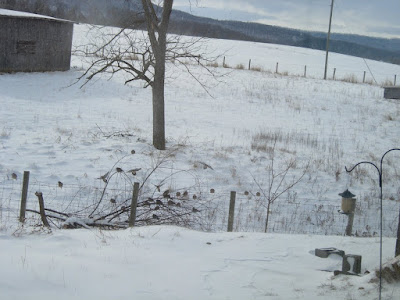
It's been a while since I posted anything here, so I figure I'll just do a compare and contrast between winter and spring. Actually, there always seems to be very little middle ground here- we swing back and forth between hot and cold in the spring.
For example, here's the thermometer today, just before noon:

And here's the thermometer about a month ago (note that I did not care to go outside to take the picture!):

Here's a view from March:

And from February:

And here's what the view looked like in early April:

Of course, we are still getting occasional frosts at night. Here are some super-cool ice crystals which appeared overnight on the trunk of my car last week:
For example, here's the thermometer today, just before noon:
And here's the thermometer about a month ago (note that I did not care to go outside to take the picture!):
Here's a view from March:
And from February:
And here's what the view looked like in early April:
Of course, we are still getting occasional frosts at night. Here are some super-cool ice crystals which appeared overnight on the trunk of my car last week:
Saturday, March 14, 2009
Maple Festival in March
Every March, Highland County, VA, has a maple festival.
http://www.highlandcounty.org/maple.htm
Who knew you could make maple syrup this far south? Apparently, Highland County is at a high enough elevation that sugar maples do just fine there.
At one place we visited, syrup is made the old-fashioned way by boiling in pans. The steam from the boiling process exits through vents in the roof:


Other places use more modern methods (reverse osmosis).
Here's the old-fashioned way of collecting sap from the sugar maples:

And the modern way (looks much less appealing to me):

A view of a grove of the maple trees. The big box at the bottom of the hill is where they collect the sap using the modern method of tubes- the whole systems is gravity-fed.
http://www.highlandcounty.org/maple.htm
Who knew you could make maple syrup this far south? Apparently, Highland County is at a high enough elevation that sugar maples do just fine there.
At one place we visited, syrup is made the old-fashioned way by boiling in pans. The steam from the boiling process exits through vents in the roof:
Other places use more modern methods (reverse osmosis).
Here's the old-fashioned way of collecting sap from the sugar maples:
And the modern way (looks much less appealing to me):
A view of a grove of the maple trees. The big box at the bottom of the hill is where they collect the sap using the modern method of tubes- the whole systems is gravity-fed.
Subscribe to:
Posts (Atom)